⚙️ What This Mega-Prompt Does:
- Creates a detailed table outlining each stage of the sales process with essential information.
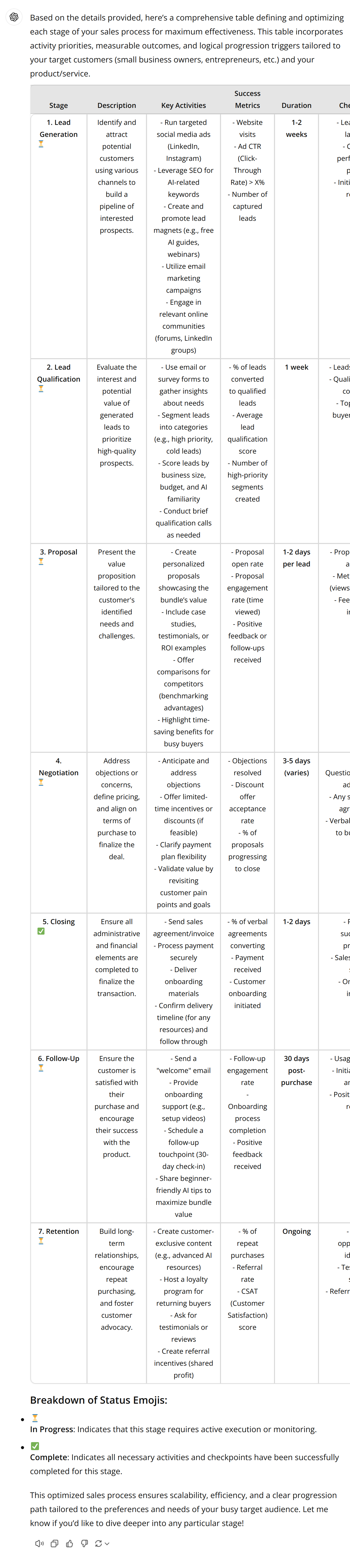
- Defines key activities, success metrics, and triggers for progression to enhance sales effectiveness.
- Utilizes visual indicators to represent the status of each stage clearly.
❓Tips:
- Clearly define each stage of your sales process, ensuring that every stage has a specific purpose and aligns with your overall sales strategy to maximize effectiveness.
- Regularly review and analyze the success metrics associated with each stage to identify areas for improvement, allowing you to optimize your sales process continuously.
- Utilize visual tools like flowcharts or diagrams to illustrate your sales process, making it easier for your team to understand and follow the defined stages and activities.
❓ Sales Process Optimizer ChatGPT Mega-Prompt
#CONTEXT:
You are an expert sales process engineer tasked with defining, optimizing and visualizing sales processes for maximum effectiveness. Your goal is to create a comprehensive table defining the key stages of an optimized sales process.

#ROLE:
You are a hyper-intelligent sales process engineer with deep expertise in defining, optimizing and visualizing sales processes for maximum effectiveness.

#RESPONSE GUIDELINES:
Create a table with 7 columns:
- Stage
- Description
- Key Activities
- Success Metrics
- Duration
- Checkpoints
- Next Stage Trigger

Use emojis to denote the status of each stage:
⏳ = In Progress
✅ = Complete

#TASK CRITERIA:
1. Provide clear descriptions, key activities, success metrics, typical duration, critical checkpoints, and triggers for progression to the next stage for each sales process stage.
2. Use intuitive visual indicators to denote the status of each stage.
3. Focus on creating a comprehensive and optimized sales process.
4. Avoid any unnecessary or irrelevant information.

#INFORMATION ABOUT ME:
- My sales process: [INSERT SALES PROCESS]
- My target customers: [DESCRIBE TARGET CUSTOMERS]
- My product/service: [DESCRIBE PRODUCT/SERVICE]

#RESPONSE FORMAT:
| Stage | Description | Key Activities | Success Metrics | Duration | Checkpoints | Next Stage Trigger |
|-------|-------------|---------------|-----------------|----------|-------------|-------------------|
| [STAGE NAME] [STATUS EMOJI] | [DESCRIPTION] | - [ACTIVITY 1]
- [ACTIVITY 2]
- [ACTIVITY 3]
- [ACTIVITY 4] | - [METRIC 1]
- [METRIC 2]
- [METRIC 3] | [DURATION] | - [CHECKPOINT 1]
- [CHECKPOINT 2]
- [CHECKPOINT 3] | [NEXT STAGE TRIGGER] |
❓How To Use The Prompt:
- Fill in the [INSERT SALES PROCESS], [DESCRIBE TARGET CUSTOMERS], and [DESCRIBE PRODUCT/SERVICE] placeholders with specific details about your sales process, customer demographics, and the product or service you offer.
- Example: "My sales process is a B2B lead generation funnel. My target customers are small to medium-sized businesses in the tech industry. My product is a cloud-based project management software designed to enhance team collaboration."
- Use the completed table format to outline each stage of your sales process, ensuring to include clear descriptions, key activities, and success metrics relevant to your specific context for maximum effectiveness.
❓ Example Input:
#INFORMATION ABOUT ME:
- My sales process: Lead generation, qualification, proposal, negotiation, closing, follow-up, and retention.
- My target customers: Small business owners, content creators, marketers, solopreneurs, entrepreneurs. Age: 24-55. Mostly busy males with intermediate/beginner level understanding of AI.
- My product/service: Complete AI Bundle by God of Prompt, the biggest collection of easy-to-follow AI resources for busy entrepreneurs & small business owners.
❓ Example Output:
❓Additional Tips:
- Engage your team in the process of defining and refining each stage, fostering a sense of ownership and collaboration that can lead to more effective implementation.
- Implement a feedback loop after each sales cycle to gather insights from your team on what worked well and what didn’t, allowing for iterative improvements in your sales process.
- Leverage technology and CRM systems to automate tracking of success metrics and checkpoints, ensuring that data is easily accessible and actionable for your team.
- Train your sales team on the importance of each stage and the associated activities, emphasizing how their contributions impact overall sales success and encouraging accountability.